Walk up the Baltoro Glacier from Askole and on day eight the moraine bends, the wind drops, and four of the world’s fourteen 8,000-metre peaks open in a 20-kilometre arc above your head. This is Concordia — the junction where the Baltoro meets the Godwin-Austen Glacier, and where, in 1892, the British surveyor William Martin Conway looked up and named the place after the Konkordiaplatz in the Swiss Alps. The name stuck because nothing else fits.
Where Concordia actually is
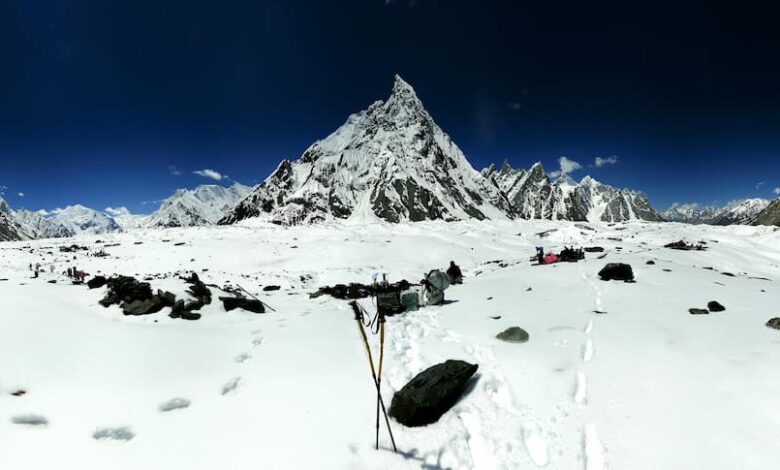
Concordia sits at 4,650 m, near 35.74° N 76.49° E, at the centre of CKNP. It’s a gravel-and-ice plateau where two glaciers meet: the Baltoro coming up from the west, and the Godwin-Austen Glacier coming down from K2 to the north. Stand at Concordia and you can see — in one panorama:
- K2 (8,611 m), to the north up the Godwin-Austen Glacier — second highest peak on earth.
- Broad Peak (8,051 m), beside K2 — twelfth highest.
- Gasherbrum IV (7,925 m), and behind it the Gasherbrum massif — Gasherbrum I / Hidden Peak (8,080 m, eleventh highest) and Gasherbrum II (8,035 m, thirteenth).
- Chogolisa (7,665 m), south.
- Mitre Peak (6,025 m), the perfect pyramid south-west.
- Marble Peak, Crystal Peak, Mustagh Tower — all in the same view.
That’s why the Italian climber Reinhold Messner called Concordia “the throne room of the mountain gods.” The phrase has stuck. Our rangers, more Pakistani in their phrasing, just say it’s where the Karakoram remembers what it is.
The throne room, then and now
The first European to reach Concordia was probably the Schlagintweit brothers, German surveyors working for the British East India Company in 1856. The first scientific expedition was Sir Martin Conway’s in 1892 — he’s the one who gave it the name. The Duke of the Abruzzi’s 1909 reconnaissance brought the photographer Vittorio Sella, and Sella’s glass-plate negatives of K2 from Concordia are still in print 115 years later. Look at his “K2 from Windy Gap” (1909) and you’ll see exactly the view today, give or take a hundred metres of glacier ablation.
The first climbers to use Concordia as a base were the 1953 American K2 expedition (Houston / Bates / Bell / Schoening). The first successful K2 ascent — Italian, 1954 — staged through it. So did the first Broad Peak ascent (Austrian, 1957) and the first Gasherbrum I ascent (American, 1958, Schoening returning). The Italian and the Austrian routes are still on the same lines today.
What it’s like to be there
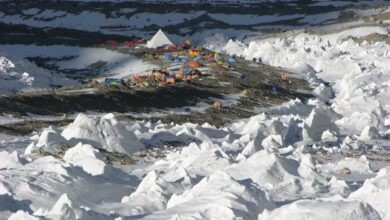
Concordia is high enough that most trekkers feel it. Headaches, insomnia, that strange flat affect that altitude brings — all normal. The campsite is bare gravel on top of the ice, no shelter, no trees, and the wind off the Godwin-Austen Glacier in the late afternoon is brutal even in July. Bring a serious sleeping bag.
The reward is the morning. We tell groups to set their alarms for first light and walk fifty metres west of the tents. From there, K2 catches the sun about ten minutes before everything else does — a single pyramid of pink at 8,611 m, the rest of the throne room still in deep blue shadow. We’ve watched it forty times between us. It hasn’t got old.
How long groups stay at Concordia
Most trekking itineraries arrive on day 8 from Askole, take a day-walk up to K2 Base Camp on day 9, and start the return on day 10. Stronger groups push for the Gondogoro La variant — up to Ali Camp on day 9, over the pass on day 10 into Hushe. We see a small number of teams stay an extra day to walk to the foot of Broad Peak (a beautiful, gentle day-walk along the moraine that almost no one does, and which gives you Broad Peak in profile against the Karakoram sky).
Practicalities
- Camping: only at the designated Concordia site, on the moraine between the two glaciers. Toilet pits are maintained by our SEED-funded waste team.
- Drinking water: from the meltwater stream that runs along the eastern edge of the camp. Filter or boil — this is glacier melt, not snowmelt; it carries fine rock dust.
- Comms: no signal. Operators bring satellite phones; we ask groups to share a check-in time with the Skardu office.
- Weather: stable in July; September brings the first proper snow. October is closed.
Beyond the throne room
Concordia is the gateway to the rest of the Central Karakoram, not the end. From here, technical climbers head north to K2, east to the Gasherbrums and over the Conway Saddle to the Sino-Pakistan border, or south over the Gondogoro La to Hushe. The walking trekker can take in the whole panorama, sit a day, and walk back — and that is, by some distance, the best mountain decision most people will ever make.
If you’re planning a trek that includes Concordia, see our notes on Classic Treks, on the highest peaks, and on the permits and rescue arrangements you’ll need before you start.
Frequently asked questions
Where is Concordia?+
Why is Concordia called the Throne Room of Mountain Gods?+
Who first reached Concordia?+
How long should I plan to stay at Concordia?+
What is the campsite like at Concordia?+
When is the best time to be at Concordia?+
Can I see K2 from Concordia?+
What gear do I need for Concordia?+