
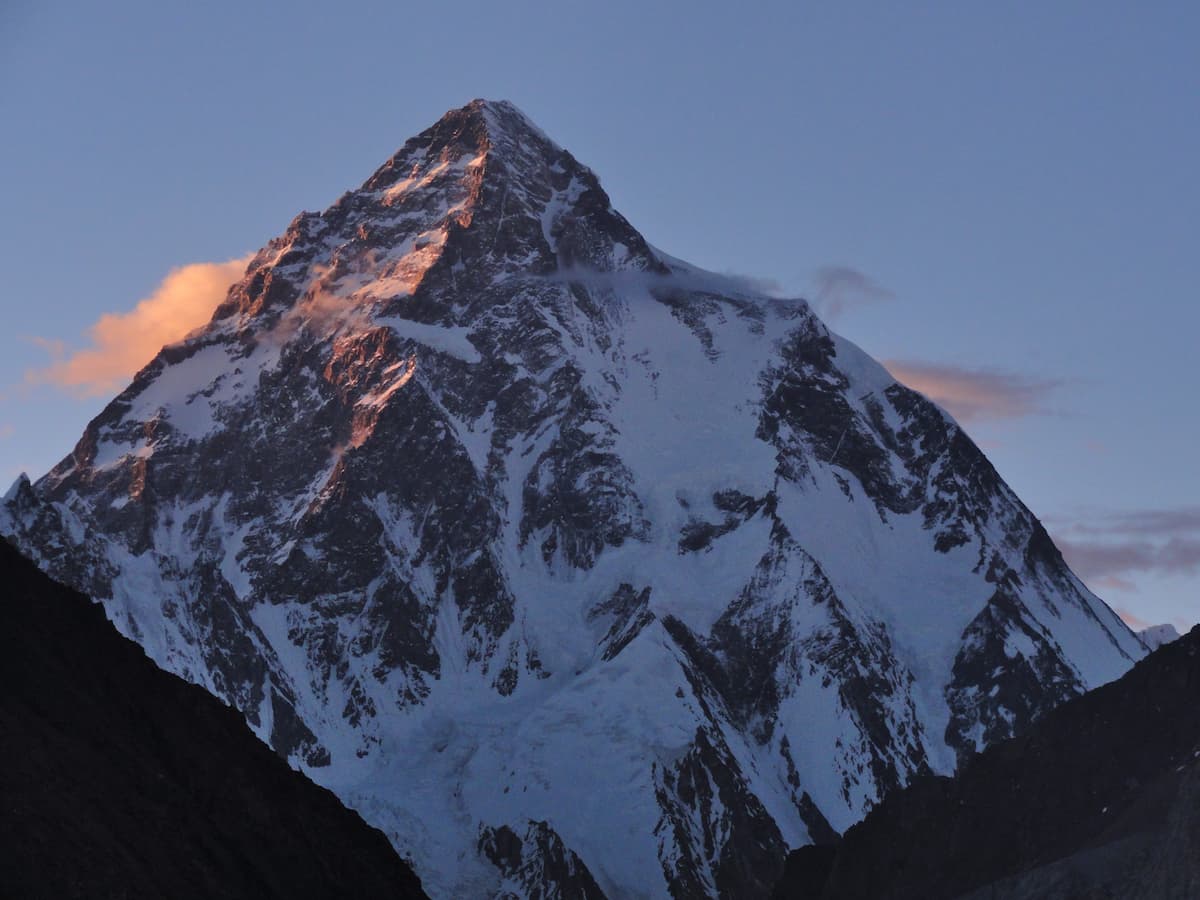
The story of climbing in the Central Karakoram is essentially the story of K2. Other peaks in this park have their own histories — the Trango Towers, Broad Peak, the Gasherbrums — but K2 is the mountain that defined the range for the climbing world, and the mountain that gave the park its identity. From the first measured glimpse of it in 1856 to the death-haunted commercial seasons of the 2020s, here is what we know about how people have tried to climb K2 and the peaks around it.
The first sight (1856) and the first reconnaissance (1861)
K2 entered the European record in 1856 when the British surveyor Thomas Montgomerie measured it from across the Indus valley using triangulation. He was working as part of the Great Trigonometrical Survey of India, and from a station roughly 200 km away he triangulated the height of two peaks in the Karakoram, marking them in his notebook simply as K1 (later identified as Masherbrum) and K2. The K stood for Karakoram. The K2 designation stuck because no widely-accepted local name was identified at the time — the Balti called it Chogori (“great mountain”), but Montgomerie’s mapping notation became the international name.
In 1861 Henry Haversham Godwin-Austen led the first expedition close to the mountain, mapping the upper Baltoro Glacier and the glacier system that flows directly south from K2 — a system that bears his name today. It was Godwin-Austen who first described what we now call Concordia.
The first climbing attempts
1902 — Eckenstein-Crowley expedition
The first real climbing attempt on K2 was a privately-funded expedition led by the British climber Oscar Eckenstein with the occultist-poet Aleister Crowley, an Austrian-Swiss climbing party, and the artist V. Wessely. They reached around 6,500 m on the north-east ridge before bad weather and disagreements drove them back. Eckenstein’s expedition is mostly remembered today for its disorganisation and Crowley’s subsequent self-mythologising, but it produced the first competent climbing-grade survey of K2’s south side.
1909 — The Duke of the Abruzzi reconnaissance
Luigi Amedeo, Duke of Abruzzi, led the most consequential pre-war expedition. With the alpine guide Vittorio Sella as photographer, the team reconnoitered K2 from every approachable angle and identified the south-east ridge — what we now call the Abruzzi Spur — as the most viable climbing line. They reached 6,250 m. Sella’s glass-plate photographs from that expedition are still the canonical images of K2 today, and the Abruzzi Spur is still the route 95% of K2 expeditions use.
1939 — Wiessner’s lost expedition
The German-American climber Fritz Wiessner came within 250 vertical metres of the summit in July 1939 before turning back. The descent went catastrophically wrong: a Sherpa support party that climbed up to support Wiessner’s second attempt got hit by storms; Dudley Wolfe died at Camp VII; three Sherpas (Pasang Kikuli, Pasang Kitar, Pintso) disappeared above 7,500 m trying to rescue him. Four deaths on a single attempt, the highest death toll on a single 8,000-metre expedition until that point. The 1939 expedition is the dark side of K2’s pre-war history.
1953 — Houston’s American expedition
Charles Houston led the first American post-war attempt. The team reached Camp VIII at 7,750 m before Art Gilkey developed thrombophlebitis and the decision came down to either abandoning him or attempting to bring him down through a storm. They chose the descent. On the way, Pete Schoening — in what became known as “The Belay” — held the falling weight of five teammates on a single ice axe braced against the slope. All five survived. Gilkey was lost in an avalanche soon after. The 1953 expedition produced no summit but produced the most-cited rescue ethic in mountaineering: your party is your responsibility, not the summit.
1954 — The first ascent
The first ascent of K2 was Italian. Achille Compagnoni and Lino Lacedelli reached the summit on 31 July 1954, on the Abruzzi Spur, supported by an expedition that included the leader Ardito Desio (who would later found the Ev-K2-CNR Committee and become a key figure in the foundation of CKNP itself).
The expedition was bitterly contested in its aftermath. Walter Bonatti and the Hunza porter Mahdi spent a night in the open at 8,100 m supplying oxygen to Compagnoni and Lacedelli, then descended in the dawn while the summit pair pushed on. Bonatti’s account of the events differed sharply from the official Italian version, and the dispute — over whether Compagnoni had moved the summit camp out of Bonatti’s reach, and whether oxygen had been used dishonestly — took fifty years to resolve. The Italian Alpine Club’s 2007 commission found in Bonatti’s favour. None of which changed the fact that Compagnoni and Lacedelli stood on the summit on 31 July.
The second ascent and after
K2 was not climbed again until 1977 — by a Japanese team led by Ichiro Yoshizawa, with Ashraf Aman becoming the first Pakistani on the summit. Reinhold Messner soloed it in 1979 (without the Magic Line, which he had originally planned). The first ascent without supplementary oxygen was Doug Scott’s 1986 attempt — though it was Wanda Rutkiewicz who became the first woman to summit K2 the same year, also without oxygen.
The 1986 season is itself one of the dark anniversaries: thirteen climbers died on K2 in a single summer, including Rutkiewicz’s teammate Liliane Barrard. Storm-trapped climbers, mishandled descents, and the brutal exposure of the upper Abruzzi Spur combined to produce a death rate that took the climbing community years to absorb.
The 8,000-metre peaks of CKNP
K2 is one of four 8,000-metre peaks inside the Central Karakoram National Park. The other three, all on the eastern side of the Baltoro / Concordia complex:
- Gasherbrum I / Hidden Peak (8,080 m). First ascent: Pete Schoening and Andy Kauffman, American expedition, 5 July 1958. Lower technical difficulty than K2 but more remote.
- Gasherbrum II (8,035 m). First ascent: Fritz Moravec, Sepp Larch and Hans Willenpart, Austrian expedition, 7 July 1956. Considered the easiest 8,000-er in the Karakoram.
- Broad Peak (8,051 m). First ascent: Hermann Buhl, Kurt Diemberger, Marcus Schmuck and Fritz Wintersteller, Austrian, 9 June 1957. Buhl had already climbed Nanga Parbat solo four years earlier; he died less than three weeks after Broad Peak attempting nearby Chogolisa.
The 7,000-metre peaks — granite walls and big-wall climbing
Beyond the 8,000-ers, the Karakoram’s great climbing identity has been the granite walls of the Trango and Cathedral groups, and the high technical peaks of the upper Hushe.
- Trango Nameless Tower (6,239 m): the south-east face is one of the largest sheer granite walls on earth. First climbed by a British team in 1976. Free-climbed in the 2010s.
- Great Trango Tower (6,286 m): the north-west face is roughly 1,340 m of vertical granite, one of the longest big-wall lines in the world.
- The Ogre / Baintha Brakk (7,285 m): in the Biafo basin. First climbed by Doug Scott and Chris Bonington in 1977; the descent — with Scott’s legs broken and Bonington with broken ribs — is one of the most-told survival stories in mountaineering.
- Latok I (7,145 m): the north ridge is widely considered the most-attempted, never-climbed objective in mountaineering. First completion of the full ridge: Russian team, 2018.
- Masherbrum (7,821 m): first climbed in 1960 by an American-Pakistani expedition.
Why K2 is harder than Everest
Numerically: roughly 1 in 4 people who summit K2 die on it. The historical death-to-summit ratio is around 23% — though this has dropped significantly in the commercial era from 2014 onwards. By comparison, Everest’s ratio sits at around 4%.
The reasons are technical and geographic. K2 is steeper than Everest top to bottom — there is no “walking” section above 8,000 m. The Bottleneck and the traverse below the summit serac are exposed to ice fall in a way no Everest section is. The weather windows are shorter. And rescue is functionally impossible: there is no Khumbu Icefall medical team, no helicopter staging at base camp. If you can’t descend under your own power past Camp III, the calculus of survival turns very fast.
The commercial era
K2 became commercialised in the 2010s, with Nepali expedition operators — many of them led by Sherpas who had already turned Everest into a commercial machine — bringing oxygen, fixed ropes, and large support teams to the Abruzzi Spur each summer. The first all-Nepali winter ascent (January 2021, by a 10-strong team led by Nirmal Purja) was the last of the 14 8,000-ers to be summited in winter.
The commercial seasons have produced higher summit numbers but have also produced their own controversies — queues at the Bottleneck, climbers stepping over dying teammates on summit day, the over-fixing of ropes, the fragility of supplemental-oxygen-dependent ascents. The 2008 season disaster — in which 11 climbers died over two days after a serac collapse cut fixed ropes during a queued descent — was the most-publicised of these.
Climbing in the park today
Mountaineering inside CKNP is permitted under the Alpine Club of Pakistan licensing system, which we counter-sign for any peak inside park boundaries. Permits are required at least three months in advance for peaks above 6,500 m. Each expedition is assigned a liaison officer and pays an environmental fee that supports the campsite waste-management programme on the Baltoro. Free-climbing peaks (under 6,500 m) inside CKNP are subject to the standard trekking permit only.
Approach treks — up the Baltoro, into the Hispar basin, into the upper Hushe — are not climbing, but they are the gateway to all of it. If you want to walk among the peaks without climbing them, the K2 Base Camp trek stands at Concordia and looks at the same skyline that Vittorio Sella photographed in 1909.
Reading list
- Walter Bonatti, Mountains of My Life (1998 Italian / 2001 English).
- Charles Houston and Robert Bates, K2: The Savage Mountain (1954).
- Greg Mortenson, Three Cups of Tea (with caveats — the geography is good).
- Ed Viesturs, K2: Life and Death on the World’s Most Dangerous Mountain (2009).
- Fosco Maraini, Karakoram: The Ascent of Gasherbrum IV (1959).
- Vittorio Sella photographs, available in many archive collections; the Italian K2 Museum in Skardu holds prints.
For the trek that takes you to the foot of all of this, see K2 Base Camp Trek — Full Guide. For the conservation context that makes climbing inside CKNP possible at all, our Ev-K2-CNR / SEED legacy page.

