
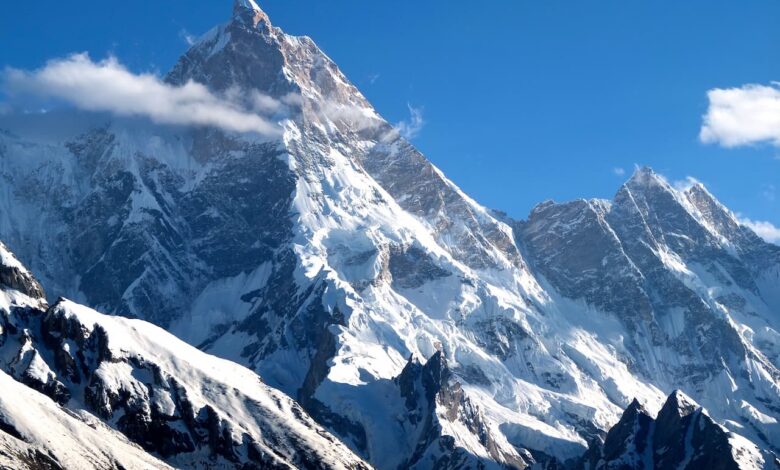
If the Baltoro is the great corridor of the western Karakoram, the Hushe valley is its quieter, more vertical mirror. Tucked into the southern flank of CKNP, the Hushe drainage gives access to Masherbrum, the Charakusa peaks, the Gondogoro La traverse out of Concordia, and a string of Balti villages that see a fraction of the visitor traffic the Baltoro does. Imran on our ranger team has guided in the Hushe for six seasons. This is the working picture.
Where the Hushe valley is
The Hushe valley runs roughly north from Khaplu on the Shyok River up into the Karakoram heart, terminating at the village of Hushe at 3,200 m. Beyond Hushe the valley splits: the Charakusa drainage goes north-east toward Hidden Peak; the main valley climbs north to the foot of Masherbrum (7,821 m); a third branch heads north-west to the Gondogoro La pass and the descent off the Baltoro into the Hushe is the dramatic exit route from the K2 Base Camp circuit.
Driving time: 5–6 hours by jeep from Skardu. The road is rougher than the Karakoram Highway but easier than the Askole road on the Baltoro side.
What the Hushe is famous for
The Masherbrum approach
Masherbrum (7,821 m, K1 in the original Montgomerie survey) is the single defining peak of the Hushe drainage. From the village you can walk to base camp at 4,300 m in two days. The mountain’s south face — a 4,000-metre wall of granite and ice — is one of the most visually intimidating things in the Karakoram. First climbed in 1960 by an American-Pakistani expedition.
The Charakusa Glacier and big-wall climbing
The upper Charakusa is a granite playground that has produced some of the hardest big-wall climbing in the world over the last twenty years. K7 (6,934 m), Hassin Peak, Charakusa Tower, the Naltar Spire — all in a basin two days’ walk from Hushe. Doug Scott, Steve House, Vince Anderson, Ines Papert and a generation of cutting-edge alpinists have all worked here. For trekkers, the walk to Charakusa Glacier base camp is itself one of the great valley walks of the Karakoram.
The Gondogoro La — the K2 BC exit route
For trekkers descending from Concordia, the Gondogoro La pass (5,545 m) is the technical alternative to retracing the Baltoro. Up from Concordia to Ali Camp (4,950 m), over the pass at dawn with fixed ropes and crampons, and down into the Hushe drainage. Dramatic, demanding, only suitable with an Alpine Club of Pakistan-certified guide. Many climbers consider the descent into Hushe one of the most rewarding traverses in mountain travel.
Saicho meadow
An hour’s walk above Hushe village, Saicho is a wide grass-and-juniper meadow set against Masherbrum’s south face. Day-hikers who don’t want to commit to a multi-day trek can get from Skardu to Saicho and back inside three days, with one night in the meadow. The view of Masherbrum at sunset from here is exceptional.
Balti culture, smaller scale
Hushe is a working Balti village — stone-and-timber houses, terraced barley and apricot fields, juniper grove on the slope above. Less commercialised than Karimabad in Hunza, less visited than Skardu. Good homestay options, less English than Hunza, more authentic Balti cuisine.
Wildlife
The Hushe drainage is one of the highest-priority areas in CKNP for snow leopard and brown bear monitoring. Camera traps in the side drainages have produced multiple confirmed snow leopard records. Ibex are common on the high south-facing slopes; markhor on the lower forested edges. If you walk slowly and at first light, the Hushe gives you a real chance of seeing wildlife you would never see on the Baltoro.
Treks based out of Hushe
- Hushe to Saicho meadow — 1 night, easy.
- Hushe to Masherbrum Base Camp — 2 nights, moderate.
- Hushe to Charakusa Glacier — 4 nights, moderate to demanding.
- Gondogoro La traverse from Concordia — demanding, technical, ACP-certified guide required (covered fully on our K2 BC trek guide).
- K6 Base Camp — 4 nights, demanding.
Practicalities
- Permits: all multi-day treks above the village need a CKNP trekking permit. Issue at our Skardu office.
- Porters: hire from Hushe village — the porters’ association sets daily rates; the 25 kg load limit applies.
- Accommodation: homestay options in Hushe village; one or two basic guesthouses; tent camping on most treks.
- Season: June through September, with July and August best.
- Connectivity: patchy mobile signal in Hushe village; nothing past Saicho.
Why come to Hushe instead of the Baltoro
The Baltoro is the ultimate Karakoram trek, and many people come to Pakistan specifically to walk it. The Hushe is the better choice if you want shorter itineraries, smaller crowds, more direct access to a cultural village, the chance of wildlife sightings, and the Charakusa basin which is empty of trekkers but full of mountains. For climbers, the Hushe is the gateway to some of the best technical alpine on earth. For trekkers, it is one of the most rewarding alternative bases in CKNP.
For the operators who run regulated Hushe-side itineraries, see our tour operator directory. For the cultural context, our Balti, Burusho & Wakhi page.

